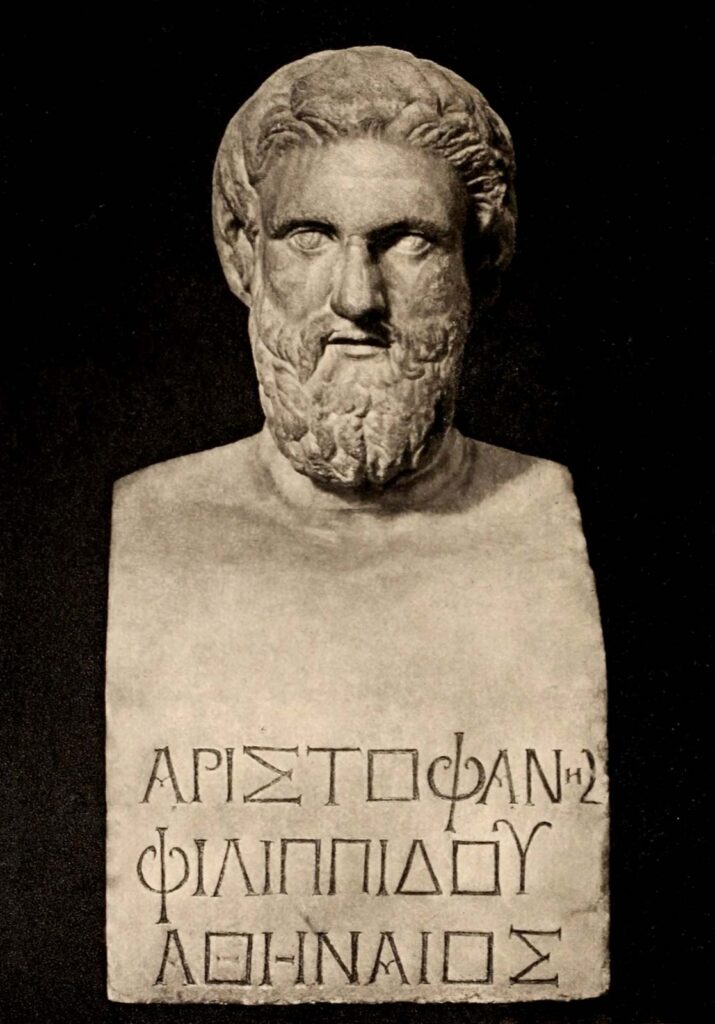
ΑΡΙΣΤΟΦΑΝΗΣ
Ο Αριστοφάνης (περ. 450–385 π.Χ.) υπήρξε ο σημαντικότερος κωμικός δραματουργός της αρχαίας Αθήνας και ο κορυφαίος εκπρόσωπος της Παλαιάς Αττικής Κωμωδίας. Έζησε κατά τη διάρκεια του Πελοποννησιακού Πολέμου, των δύο ολιγαρχικών μεταβολών και των δύο δημοκρατικών αποκαταστάσεων, γεγονός που έχει ερμηνευθεί ως ένδειξη ότι, παρά τον έντονα πολιτικό χαρακτήρα των έργων του, δεν συμμετείχε ενεργά στην πολιτική ζωή. Μετά την ήττα της Αθήνας από τη Σπάρτη, η πόλη έχασε την πολιτική της ηγεμονία, αλλά εξελίχθηκε σε σημαντικό πνευματικό κέντρο του ελληνικού κόσμου, εξέλιξη στην οποία συνέβαλε και το έργο του Αριστοφάνη. Διακρίθηκε για την οξεία σάτιρά του, με την οποία καυτηρίαζε πολιτικούς, φιλοσόφους, καλλιτέχνες, θρησκευτικές αντιλήψεις, αλλά και τη στάση των ίδιων των Αθηναίων πολιτών. Τα πρώτα του έργα παρουσιάστηκαν με τα ονόματα άλλων παραγωγών ή ηθοποιών: οι Δαιταλείς (427 π.Χ.) με το όνομα του Φιλωνίδη, οι Βαβυλώνιοι (426 π.Χ.) και οι Αχαρνείς (425 π.Χ.) με το όνομα του Καλλιστράτου. Η μεγάλη επιτυχία των Αχαρνέων τον οδήγησε να αφοσιωθεί ολοκληρωτικά στην κωμωδία. Από το πλούσιο έργο του σώζονται έντεκα σχεδόν ακέραιες κωμωδίες, μεταξύ των οποίων οι Νεφέλες, οι Όρνιθες, οι Ιππείς, οι Σφήκες, η Ειρήνη, η Λυσιστράτη, οι Θεσμοφοριάζουσες, οι Βάτραχοι, οι Εκκλησιάζουσες και ο Πλούτος. Αν και η κωμωδία της εποχής χαρακτηριζόταν από έντονη αθυροστομία, ο Αριστοφάνης τη χρησιμοποιούσε με μέτρο, μόνο όταν εξυπηρετούσε τη δράση και τη σάτιρα, διατηρώντας παράλληλα τη σύνδεση του είδους με τον διονυσιακό κῶμο, από τον οποίο προήλθε η κωμωδία.
[ΠΗΓΗ: www.classicaldrama.gr]
ARISTOPHANES
Aristophanes was the greatest comic playwright or comedy-writer of ancient Athens and the father of Old Attic comedy. He was born around 450 BC and died in 385 BC. Aristophanes survived The Peloponnesian War, two oligarchic revolutions and two democratic restorations; this has been interpreted as evidence that he was not actively involved in politics despite his highly political plays. After Athens had been defeated in war with Spartan, its empire had been dismantled and it had undergone a transformation from being the political to the intellectual center of Greece. Aristophanes was part of this transformation His powers of ridicule were feared and acknowledged by influential contemporaries He caricatured leading figures in the arts in politics, and in philosophy/religion. His plays also include criticism of the audience’s attitude. He presented his comedies with the names of his actor friends. Thus, in 427 BC, he produced “Thetalis” under the name of Philonides, in 426 BC, “The Babylonians” and in 425 BC The Acharnians (Acharnis) under the name of Kallistratus. Excited by the award for his comedy The Acharnians, the poet devoted himself completely to this theatrical genre and in the following years he wrote the comedies The Birds (Ornithes), The Clouds (Nephelles), Ecclesiazousae,, Frogs, The Knights (Ippis), Lysistrata, Peace (Irene), Wealth (Plutos), Thesmophoriazosae, Wasps (Sfiges), which together with the comedy Acharnis are the ones that are performed mostly in theatres today. In his years there was a rampant vulgarity which he reduced to foul language athyrostomia) and only where it was necessary in the spirit and development of the action, as to gain emphasis, but also as an allusive reference to the Dionysian “como”, i.e. the feast, from which comedy originated.